
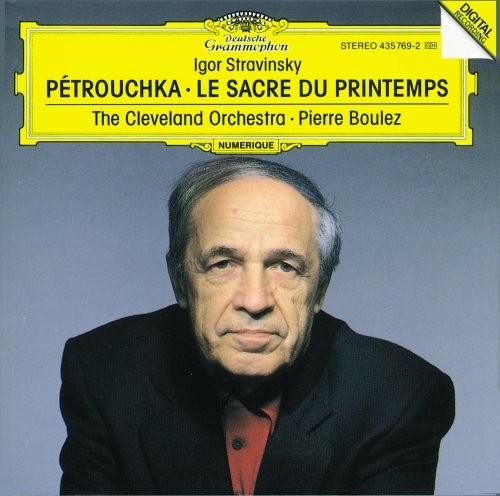
Stravinsky: Petrouchka, Le Sacre du Printemps
Pierre Boulez; The Cleveland Orchestra
16/44.1 PCM, DDD recording, March 1991, Deutsche Grammophon
Listening done on both playback systems
While it’s fairly well known amongst classical music fans, many people I talk to are genuinely shocked to find that Cleveland’s orchestra is one of the finest in the world. That might speak more to the decline of classical music in the popular consciousness as much as anything, given that Cleveland has long held its place within the pantheon of the “Big Five” American orchestras (along with Philadelphia, New York, Boston, and Chicago). Fewer people these days probably even know there is such a thing as the so-called “Big Five,” which might be partly a good thing, at least since the collection of top-rank American bands now surely extends well beyond those five famed institutions. Regardless, Cleveland richly deserves its august reputation. Its long association with the late, great Pierre Boulez helped develop that reputation, giving Cleveland a flair for French music and with Stravinsky that might be unmatched in the United States.
Here, Boulez has Cleveland in typically high form. The playing has sparkle and character, while never losing a firm grip on the dense polyrhythms Stravinsky employed to such stunning effect; more famously in The Rite, but just as critically in Petrouchka. All of the soloists distinguish themselves, but most critically, the orchestra as a whole maintains a strong sense of rhythmic pulse, regardless of crooked numbers in the time signatures. Nowhere is the more evidence than in the final Sacrificial Dance, where the fatalistic drive of those jagged rhythms builds powerfully toward a brutal collapse. And when called for, the playing is brutal — in The Rite of Spring, this is a Pagan sacrifice, after all! Across the both performance, Cleveland encapsulates all of the various moods in the two great ballets: from frenzied and joyous, to courtly and aristocratic, to wild and primal.
Deutsche Grammophon was noted for its multi-miked digital extravaganzas in the 1990s, and this recording is typically close-perspective and brightly lit. That said, the tonal characteristics of the instruments sound very true, especially the brass. There is a weight to the low brass that is often missing. Likewise the deep burp from contrabassoon in the First Tableau of Petrouchka is well caught, as are the punishing wooden mallet side-drum whacks in The Rite. The soundstage is exceptionally wide, as befits such a close perspective – extending well beyond the speakers. Soundstage depth at this perspective is not quite as deep as other recordings, but appropriate given the perceived distance one is from the players. The recording is highly detailed, but never etched or grainy, and the instrument placement in the soundstage is stable and accurate. Spotlight miking, while clearly in use, never calls attention to itself. Overall, you are allowed to find yourself in the hall and become comfortable with the sound image presented.
It has to be said that most of the recordings I have for which Boulez was the conductor sound very good. While I am not aware the extent to which Boulez was involved in the production of the recording, he either wanted the recording to capture a natural picture of the performance he rendered, or he was content to allow the engineers accomplish a natural hall perspective and orchestral balance without interference. Either way, this recording was not “conducted” from the mixing console – and that is wholly to the benefit of Boulez and his Cleveland players, with whom you can just be glad of the opportunity to share a hall and these wonderful performances.

 The Cranky Audiophile